Welcome to The Spelling Routine using Mapped Words®! Part of the Word Mapping Mastery® system. The quickest way to learn words so they stick!


MyWordz® offers Speech Sounds to Spelling Technology

The Spelling Routine
Phonemies to Spelling
How can children spell words using graphemes you haven’t taught in phonics lessons?
They type the sounds.
They check the spelling.
Then you ask:
“What’s new for you?”
That question is gold.
It switches on their pattern-seeking, prediction machines.
It invites the brain to notice new information.
The first sound in in is the same sound represented by a in sausage and a in orange.
For children only learning The Core Code, that spelling is unexpected.
And unexpected patterns are powerful.
The brain updates.
Refines its prediction.
Stores the word.
They don’t guess.
They don’t memorise.
They discover.
And they can check independently while they’re writing.
No waiting.
No supervision.
No-one hovering.
Feed the spelling brain patterns, not rules.


Use the MyWordz® technology to check the letters (graphemes) and sounds (phonemes) for that word, and then use The Spelling Routine to store it in the brain’s word bank (orthographic lexicon). With good phonemic awareness the word is stored after only one run through.
Show the Code with The Code Overlay
Interlinked Word Mapping Mastery® Learning Pathways: Easier, Speedier Reading and Spelling for All Neurotypes.
"Offer a pathway, not a pace. Phonemies are Speech Sound Monsters that show the sound code dyslexic brains struggle to hear."
Self-Paced Linguistic and Visual Phonics within the Classroom Setting| Teach Your Child to Read Birth to 7 | The Core Four for Dyslexia
Do you have a dyslexic child who’s struggling with spelling lists, and you aren’t sure how to help?
Spelling words often don’t stick, no matter how much practice they do, and it can feel like guessing, memorising, or starting again every week.
What helps
Use the free 'Lite' version of the Code Mapping Tool to type the words and generate Mapped Words® that shows which letters are graphemes. This was created for teachers using the Speech Sound Pics (SSP) Approach
Then, using that mapped word, we’ll show you a simple 60-second Spelling Routine that helps the spelling stick long-term instead of being relearned each week.
I created this to demonstrate how we would help a parent support their dyslexic child with words from their class spelling list! The word is heist


No Rules Allowed

Screenshot shared for critique and discussion. This kind of rule-based instruction is exactly what many dyslexic children experience as overwhelming and misleading. This post is about the impact, not the creator.
This is the nightmare.
Rules that aren’t rules.
Exceptions stacked on exceptions.
Dyslexic children don’t need more tricks.
They need clarity.
Support group launching soon.
No rules allowed.


English has an opaque orthography. For example, the grapheme <a> might represent one sound, as in ant and apple, but it represents at least eight other sounds in different words. Sometimes we need to forget the phonics and just show the Word Code. Word Mapping Mastery® for all.
The world’s first Code Overlay system that makes graphemes and their sound values visible directly on written text for every word in English. The structure of words is shown, designed by SpLD experts to support dyslexic brains.
WE SHOW CHILDREN WHICH LETTERS ARE GRAPHEMES AND THEIR SOUND VALUE WITH PHONEMIES
The Spelling Routine with Mapped Words® supports orthographic mapping for all neuro-types.
"Less Teaching, More Self-Teaching"
Emma Hartnell-Baker MEd SEN | Doctoral Researcher | Innovate UK Winner | Creator of MyWordz® with MySpeekie® | Word Mapping Mastery® technology with Phonemies® and the world’s first one-screen AAC | Show the Code with Mapped Words®


Have a free play of the world's first word mapping technology that shows which letters are graphemes for any word of English. https://www.speediereadies.com/orthographic-mapping-tool



Storing Words in the Brain’s Word Bank Is Easier with Mapped Words®. Struggling students can instantly see graphemes and their sound value, with no memorising whole words. Spelling with no guessing and no stressing. We create resources and activities to help dyslexic children read and spell more easily.
If they don't know it, show it!
We also use IPA aligned Speech Sound Monsters, called Phonemies. "Follow the Monster Sounds to Say the Word"
The Spelling Routine with Mapped Words® gives learners exactly what the science tells us is needed to map speech to print and store words in the brain’s word bank, the orthographic lexicon, in less than two minutes. It supports Word Mapping Mastery® by enabling self-teaching, which is the bridge between explicit phonics instruction and orthographic mapping.
Mapped Words®: Show the Code. The Brain Self-Teaches More Easily Between Birth & Age 7.


Show the Sight Word Code with Mapped Words® Neuroscience shows your child’s brain learns through understanding, not memorisation. We make the Word Code visible so the brain can learn it for itself. Mapped Words® also help EALD, ESL, and EL children pronounce high-frequency English words accurately. Mapped Words® offers all brains the quickest, easiest way to store words and then recognise them instantly when reading, including words some call 'tricky' or 'irregular', and spell them correctly when writing, independently, at any age or stage. All words become sight words when we show the sight word code and use the Spelling Routine. Speech sounds, spelling, and meaning are bonded without memorisation, strengthening phonemic awareness and phonological working memory, preventing the dyslexia paradox. No more guessing or memorisation. Parents and tutors learn to support early, easy Word Mapping Mastery® from birth. with support from Emma Hartnell-Baker aka The Word Mapper, at SpeedieReadies.com
The words in this list are in order of their frequency of use in everyday writing. As the is the most frequently used word in the English language, it appears first in the list. According to The Reading Teacher’s Book of Lists, the first 25 words account for approximately 33% of everyday writing, the first 100 words appear in around 50% of adult and student writing, and the first 1,000 words are used in approximately 89% of everyday written text. All of these words are included in the MyWordz® technology word bank. As a result, children can use MyWordz® to work out the structure and pronunciation of almost all of the words they are likely to encounter in the texts they need to read and the words they need to write. These HFWs are also explored within the series of 100 Village With Three Corners books from the One, Two, Three and Away! series used within Speedie Readies. Emma Hartnell-Baker argues that children find it easier to learn to read when they are motivated by interest in the books they are reading, and that this provides a quicker route to self-teaching.
Mapped Words®: Show the Sight Word Code
the
For previous Mapped Words® use the Search function or suggest new ones by emailing Mastery@MappedWords.com
Spelling

Meaning
Speech Sounds (Phonemes)


Word Mapping Mastery®Technology
Monster Spelling Piano (MSP) app for tablets
The Spelling Routine
The Spelling Routine is used in Reception, when children can draw lines, numbers and letters, but also offers a cost-effective and highly impactful KS2 spelling system for dyslexic students. Use it with or without Phonemies (Speech Sound Monsters®). Show the Word Code. Word Mapping Mastery® for all neuro-types.
No more memorising whole words. No more learning parts of words by heart.
Words are learned when speech sounds, spelling, and meaning are bonded together.
Learn to use The Spelling Routine so that words are stored in the brain’s word bank. Learn to support self-teaching from birth https://www.SpeedieReadies.com/parent-tutor-course
Help us build the world’s largest mapped word bank, so anyone, anywhere can see orthographic mapping in real time for every word. No more heart words.


This is different from anything else because MyWordz® technology shows the word already mapped. We show speech sounds with Phonemies and call graphemes 'pictures of speech sounds' ie Speech Sound Pics®! We show the sight words orthographically mapped.
Speech sounds (phonemes), spelling (Sound Pics®), and meaning are made visible together, and the learner completes a short spelling routine to store the word in the orthographic lexicon. Nothing is guessed. Nothing is memorised. Nothing depends on whether the graphemes have been “taught yet”. Phonemic awareness and phonological working memory is strengthened. This is crucial for dyslexic learners.
Phonics programmes try to get learners to infer this structure over time. Some ask chilren to learn words with graphemes they don't cover as 'tricky' and ask children to learn those graphemes by 'heart'. Whole language skips word mapping entirely.
This makes the structure explicit, in the moment, for any word. Any time.
That shift, from instruction to visibility, is what changes outcomes. Emma Hartnell-Baker has shifted the focus away from often ill-informed instruction and towards making the code visible so the brain can learn it for itself. Miss Emma is also known as The Word Mapper!


I realised it was time to stop fighting the existing reality and build something new. Something that brains could use to teach themselves, in the same way children learn spoken language, and in the way some children have managed to learn to read for decades without instruction, regardless of the latest fad or supposed evidence.
To stop adults asking children to memorise whole words, or to learn parts of words “by heart”, the same approach repackaged to sound more palatable to phonics advocates but still missing the mark, I needed to show the code. A code already shown universally, in part, through the IPA.
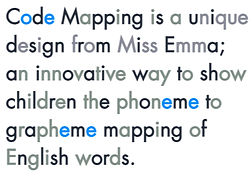
In 2012, Code Mapping® was developed as an Orthographic Mapping Tool, using black and grey coding, with blue to highlight split digraphs, referred to as Sound Pic® Sandwiches. This made the graphemes visible. It was used within classrooms using the Speech Sound Pics (SSP) Approach. In those reception classrooms teachers do not teach phonics, children learn the Code Code using my tech and resources at their own pace with teachers freed up to montor the learning of children as individuals.
In 2014, I added the missing piece by making the phonemes visible, through Speech Sound Monsters®, now also known as the Phonemies® Family. I called it Monster Mapping® initially. When I returned to England I saw a phonics programme using 'Monsters' and needed to distance myself from that.
By showing both the graphemes and the phonemes, alongside meaning, the full code becomes visible. When children can see the speech sounds, the spelling, and the meaning together, and especially if they use my Spelling Routine, those elements bond in memory and are stored in the brain’s word bank. This approach bypasses ill-informed instruction and moves learners directly into self-teaching at speed.
That is Speedie Word Mapping, and it is the driver of Word Mapping Mastery®.


Parents need to understand what children’s brains require in order to store words, and to integrate this into daily life from birth, alongside talking, singing, and reading stories.
For children whose brains are already wired to find reading and spelling easy, parents strengthen connection and confidence through shared language and stories. These are the children who are later often described as having “taught themselves to read”. I want parents to understand how that actually happened, so this knowledge is no longer mysterious or reserved for a lucky few.
For the one in four children who will never read or spell at a level required to learn successfully in school without the right support, parents become their first and most important dyslexia coaches from birth. By understanding what their child’s brain needs, parents can help them avoid the damaging “wait to fail” that is still built into the system, often with no guarantee that any later intervention will truly work for them. This is why parents are one of the most powerful forces we have in preventing the current so-called SEN crisis. I share this knowledge through training sessions for members, while continuing to make many Speech Sound Play and Speech Sound Pics Approach resources freely available for those who need them.

Our Dyslexia Tutors Don’t Teach Just Phonics.
They SHOW Phonics. Speedie Phonics!
Less Teaching. More Self-Teaching.


Speedie Orthographic Mapping: The Brain Self-Teaches More Easily Between Birth and Age 7.
Sign up for the Getting Started with Speedie Word Mapping training session, and order the Monster Spelling Mat and other resources to support word mapping at SpeedieReadies.com


The primary domain for this site is TheSpellingRoutine.com. This site focuses on The Spelling Routine using Mapped Words®, part of Word Mapping Mastery®. The domain was updated from MappedWords.com for clarity. The Spelling Routine supports whole class instruction through the Speech Sound Pics (SSP) Approach, and 1:1 learner support through Speedie Readies.

